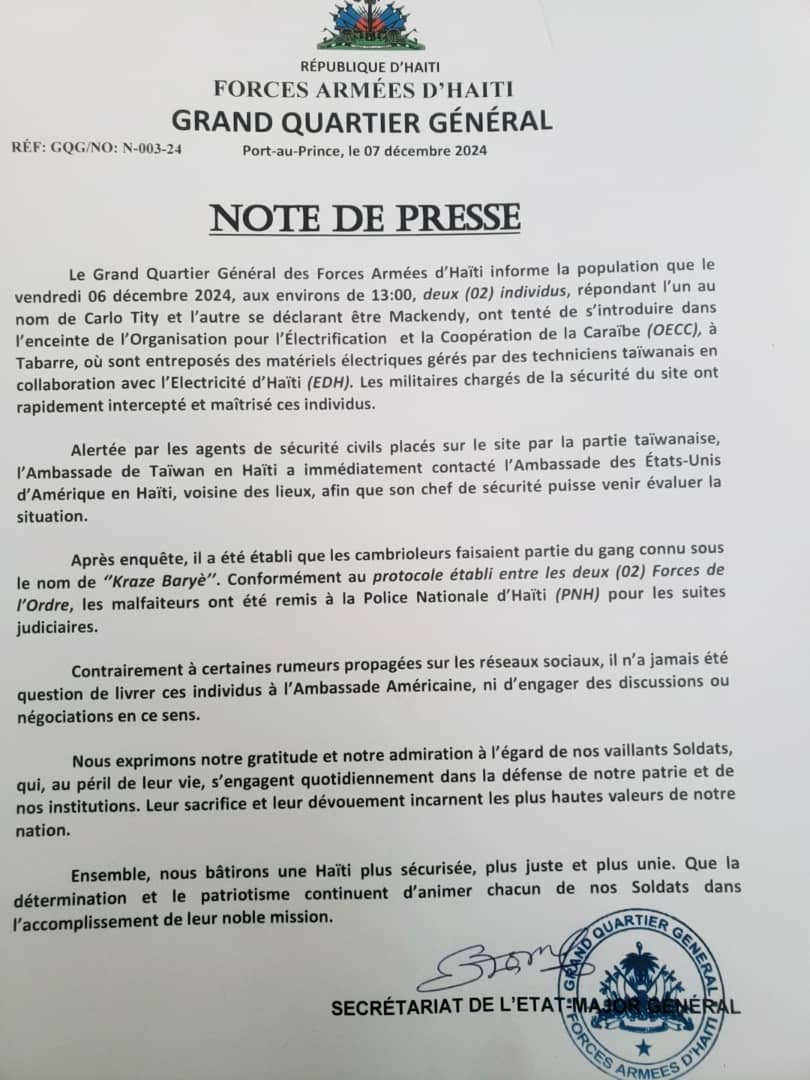
At first, I dismissed the rumors. The story – Haitian soldiers arresting gang members, only to have the U.S. Embassy intervene and demand their release – seemed too far-fetched, another fabrication for viral outrage on Haitian social media. Then came the press release from the Haitian Army. The explanation offered – that Taiwan contacted the U.S. Embassy, not Haitian authorities – was as odd as it was familiar, a Proustian reminder of the long history of U.S. security services taking an active and often intrusive interest in Haiti’s security affairs.
Taiwan’s decision to bypass Haitian authorities in favor of the U.S. underscores the international community’s lack of trust in local institutions. It reinforces the perception that Haiti is managed by proxies rather than as an independent nation. Despite the Haitian Army’s direct involvement in the arrests, Taiwan sought U.S. mediation, sidelining Haitian sovereignty and exposing where real power lies when it comes to Haiti’s security. This is especially ironic given that the incident occurred at a site of Haitian-Taiwanese collaboration. While Taiwan’s move may have been pragmatic, it primarily underscored Haiti’s diminished autonomy.
This situation brings to mind Haiti’s historical struggles against foreign interference. From the CIA’s creation of the Service d’Intelligence National (SIN) in the 1980s to its support of paramilitary groups like FRAPH in the 1990s, and including their interventions in the following decades, such as the second coup d’état against Aristide in 2004, U.S. actions have consistently undermined Haitian governance while empowering actors who prioritize foreign interests. The rumor of U.S. drone surveillance and pressure on the Haitian military taps into a collective memory of betrayal, making it easy for Haitians to believe their institutions remain subject to foreign control.
The outrage on social media is reflective of a deeper frustration with the recurring erosion of sovereignty. The U.S. Ambassador’s recent admission of security contacts with gangs only adds to the mistrust, making interference plausible – even when unproven. This incident, like many before it, reinforces the belief that Haiti’s sovereignty is perpetually under siege. Haitians feel betrayed not only by foreign powers but also by their own institutions, which seem unable or unwilling to stand up to external pressures.
If Haiti is to break this cycle, its allies must respect its institutions. The decision to bypass Haitian authorities was a symbolic blow—a clear indicator that Haiti is still seen as incapable of managing its own affairs. For this to change, both Haiti and its partners must commit to a relationship built on mutual respect and trust. Otherwise, perhaps all parties should heed the U.S. President-elect’s recent tweet about Syria and foreign conflicts, urging the U.S. administration to « not engage. »




 la loi de ma bouche
Répondre à TiZ Annuler la réponse.